Loyalty Research & Revamp

Loyalty Research & Revamp

When loyal customers can't find their rewards: A UX research study on Lotus's loyalty program, and the coupon and reward redesign it led to.

When loyal customers can't find their rewards: A UX research study on Lotus's loyalty program, and the coupon and reward redesign it led to.

UX Research

Product UX

TYPE:

UX Research & Revamp

ORG.:

Lotus's, Thailand

YEAR:

2023

DURATION:

6 months

Project Snapshot

Contribution

Contribution

On the research, I planned the strategy, moderated the usability sessions, and wrote the synthesis, partnering with Nathapon Anunswat. On the redesign that followed, I was the sole designer for the loyalty coupon and reward surfaces, with the team reviewing throughout.

On the research, I planned the strategy, moderated the usability sessions, and wrote the synthesis, partnering with Nathapon Anunswat. On the redesign that followed, I was the sole designer for the loyalty coupon and reward surfaces, with the team reviewing throughout.

Context

Context

Lotus's loyalty program in the Lotus's app (retail chain, Thailand), 2022. Initiated by the business and marketing teams, with about four months of research across product, development, marketing, customer insight, and loyalty teams.

Lotus's loyalty program in the Lotus's app (retail chain, Thailand), 2022. Initiated by the business and marketing teams, with about four months of research across product, development, marketing, customer insight, and loyalty teams.

Methods

Methods

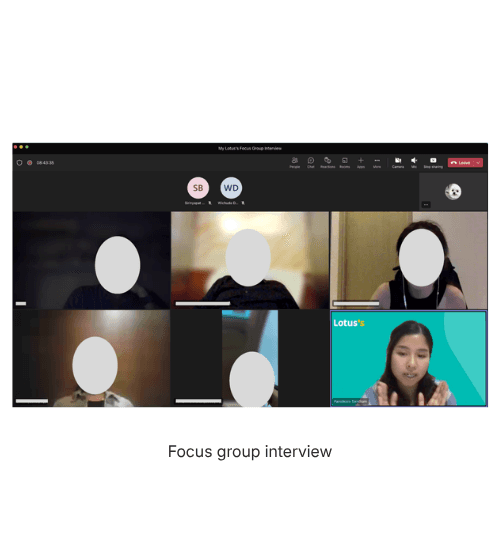
Data analytics, desk and competitor research, a survey, focus group interviews (28) and one-to-one usability tests (10), a cross-functional ideation workshop, and quick concept validation.

Data analytics, desk and competitor research, a survey, focus group interviews (28) and one-to-one usability tests (10), a cross-functional ideation workshop, and quick concept validation.

The real problem was hidden, even from users
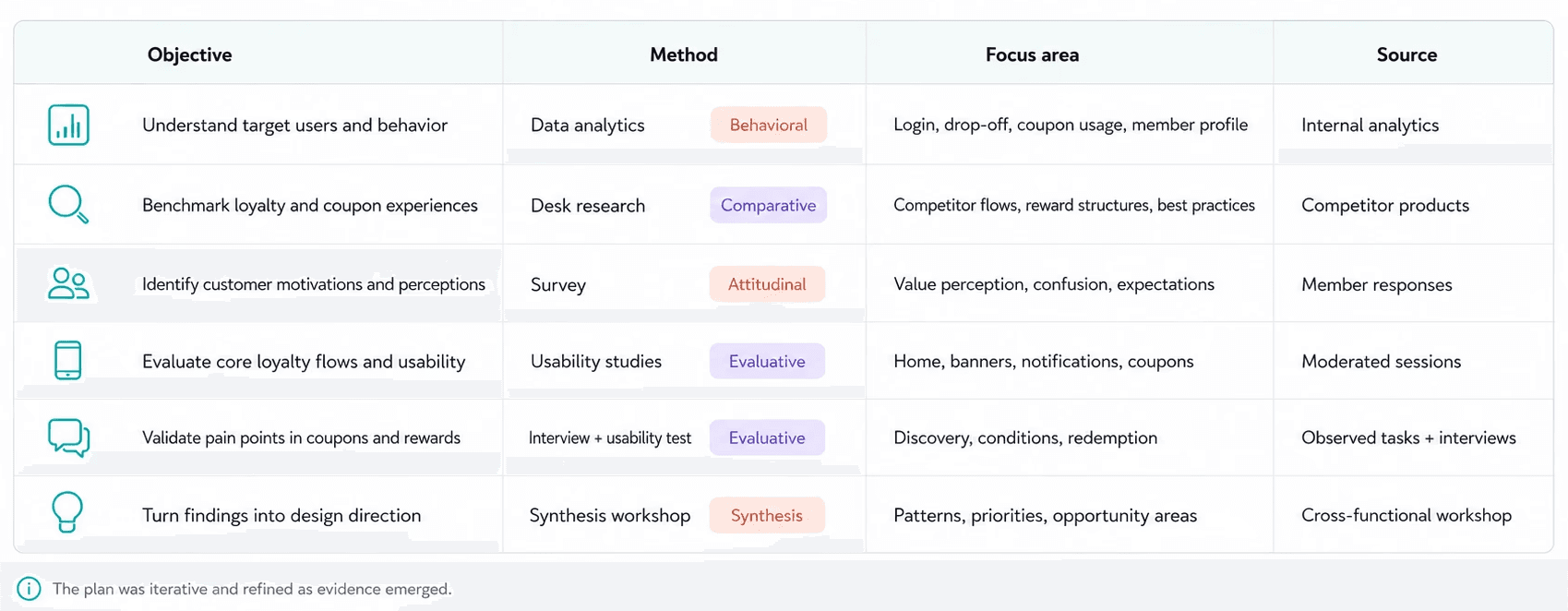
The business and marketing teams could see the loyalty features were underperforming, but no one, not even users, could say exactly why.

So the first job was deciding what to investigate. I turned the business brief into a structured research plan myself, mapping every question to a method, an owner, and a data source.

That plan came first. Everything we learned came out of running it.

The business and marketing teams could see the loyalty features were underperforming, but no one, not even users, could say exactly why.

So the first job was deciding what to investigate. I turned the business brief into a structured research plan myself, mapping every question to a method, an owner, and a data source.

That plan came first. Everything we learned came out of running it.

Showcase image

The business brief was translated into a structured research plan before any assumptions were made.

Listening across the whole loyalty experience
We expected a coupon problem. What we found was bigger.

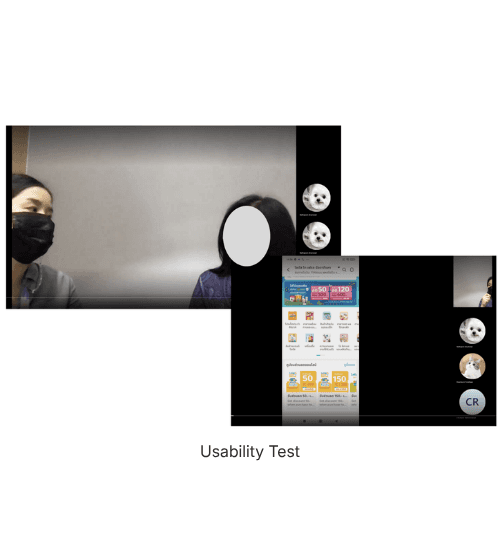
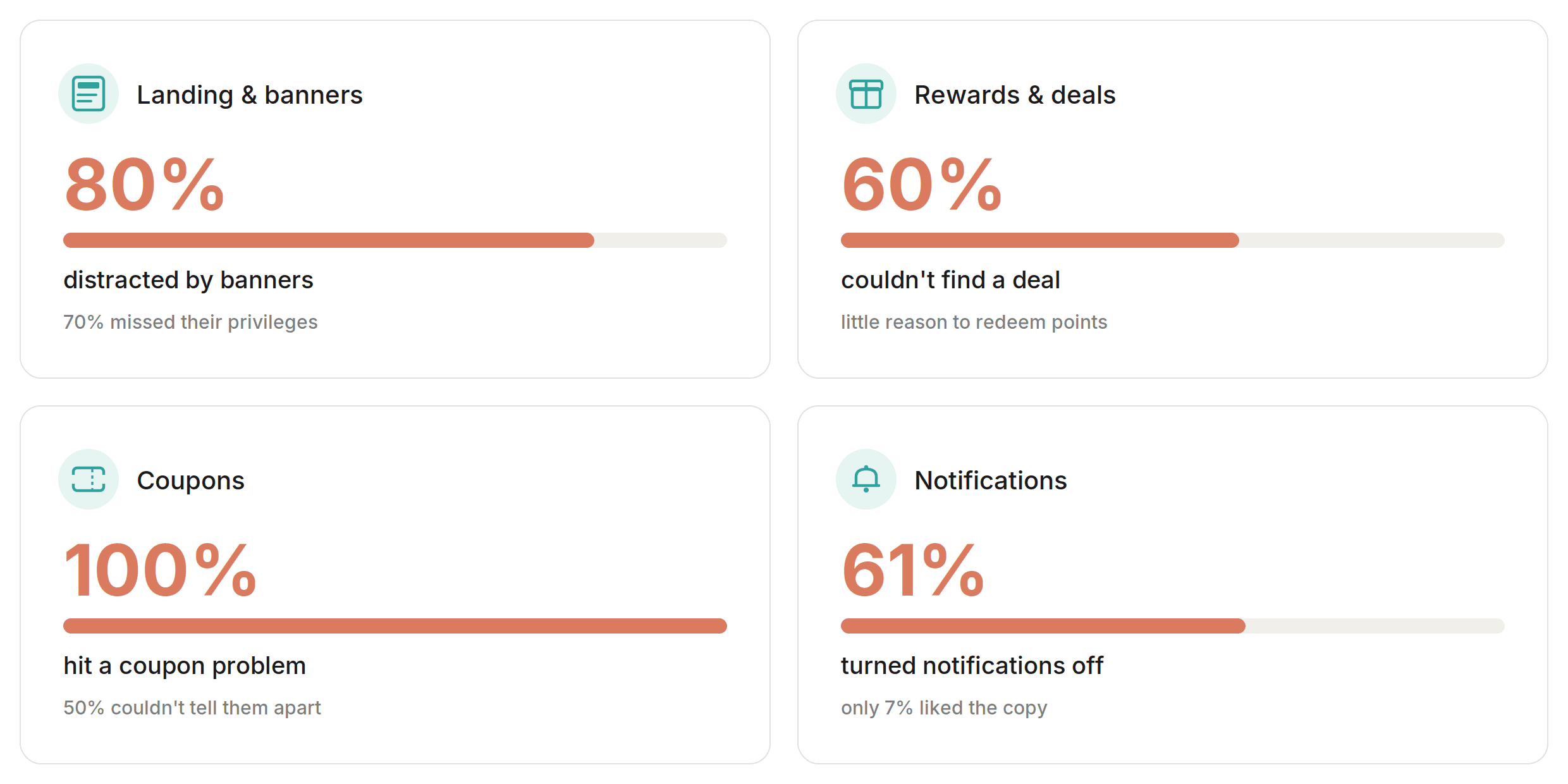
We tested real shopping goals with 38 members, from finding a Coke online to a microwave in store. The friction showed up everywhere, not just in coupons:

  • Home screen. People were overwhelmed and could not tell coins, coupons, and hot deals apart. Few knew which privileges they had.

  • Banners. Attractive one at a time, but cluttered in context and distracting from the task.

  • Notifications. Long and spammy next to competitors' shorter, more urgent messages.

  • Coupons, the worst. In the redeem task, nearly half of participants could not finish. Rewards looked alike, partner names were unclear, and categories were too small to notice.

We expected a coupon problem. What we found was bigger.

We tested real shopping goals with 38 members, from finding a Coke online to a microwave in store. The friction showed up everywhere, not just in coupons:

  • Home screen. People were overwhelmed and could not tell coins, coupons, and hot deals apart. Few knew which privileges they had.

  • Banners. Attractive one at a time, but cluttered in context and distracting from the task.

  • Notifications. Long and spammy next to competitors' shorter, more urgent messages.

  • Coupons, the worst. In the redeem task, nearly half of participants could not finish. Rewards looked alike, partner names were unclear, and categories were too small to notice.

Showcase image
Showcase image

What the research found across the loyalty experience. Coupons hurt the most, so they became the redesign focus. Each area pointed to a direction: cut the overload on landing, suggest relevant deals, reorganize coupons, and fix notification copy.
From a pile of findings to a prioritized plan
Insights only matter when they change what gets built. Turning ours into a ranked, buildable plan is the part of this project I am proudest of.

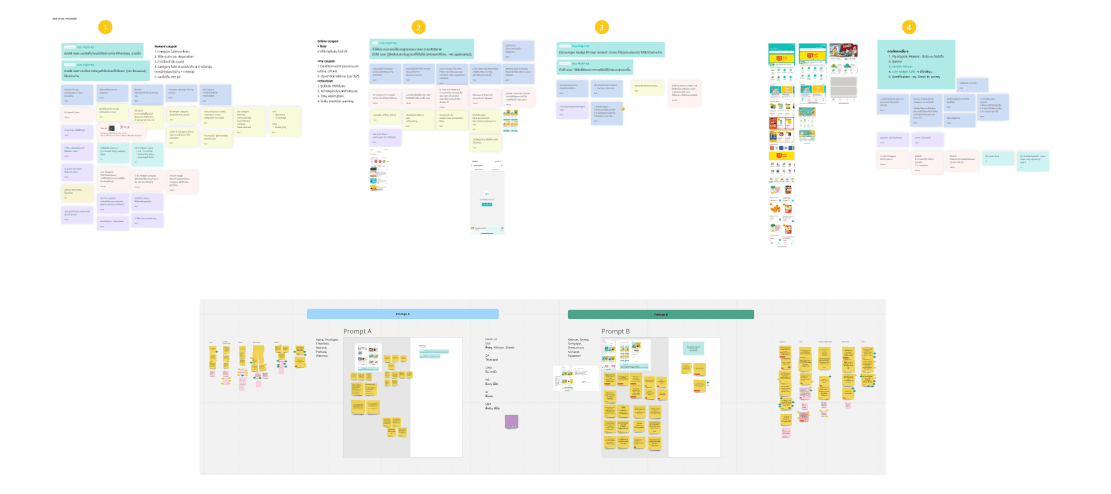
Rather than designing solutions alone, I moderated a cross-functional ideation workshop with product, engineering, and marketing. Each team brought a lens I do not have, opening up ideas I would not reach on my own, while the developers kept every one grounded in what we could actually build.

We then weighed every issue on three things: user impact, build difficulty, and whether the effort was worth the value. Tagging technical dependencies with the developers meant each recommendation carried a sense of cost, not just ambition.

That produced a ranked plan, not a wish list, covering everything from coupons and search to banners, notifications, and privilege awareness. This portfolio follows one piece of that plan: the coupon work.

Insights only matter when they change what gets built. Turning ours into a ranked, buildable plan is the part of this project I am proudest of.

Rather than designing solutions alone, I moderated a cross-functional ideation workshop with product, engineering, and marketing. Each team brought a lens I do not have, opening up ideas I would not reach on my own, while the developers kept every one grounded in what we could actually build.

We then weighed every issue on three things: user impact, build difficulty, and whether the effort was worth the value. Tagging technical dependencies with the developers meant each recommendation carried a sense of cost, not just ambition.

That produced a ranked plan, not a wish list, covering everything from coupons and search to banners, notifications, and privilege awareness. This portfolio follows one piece of that plan: the coupon work.

Showcase image
Showcase image

Ideation workshop was conducted online via Figma and Miro across multifunctional team
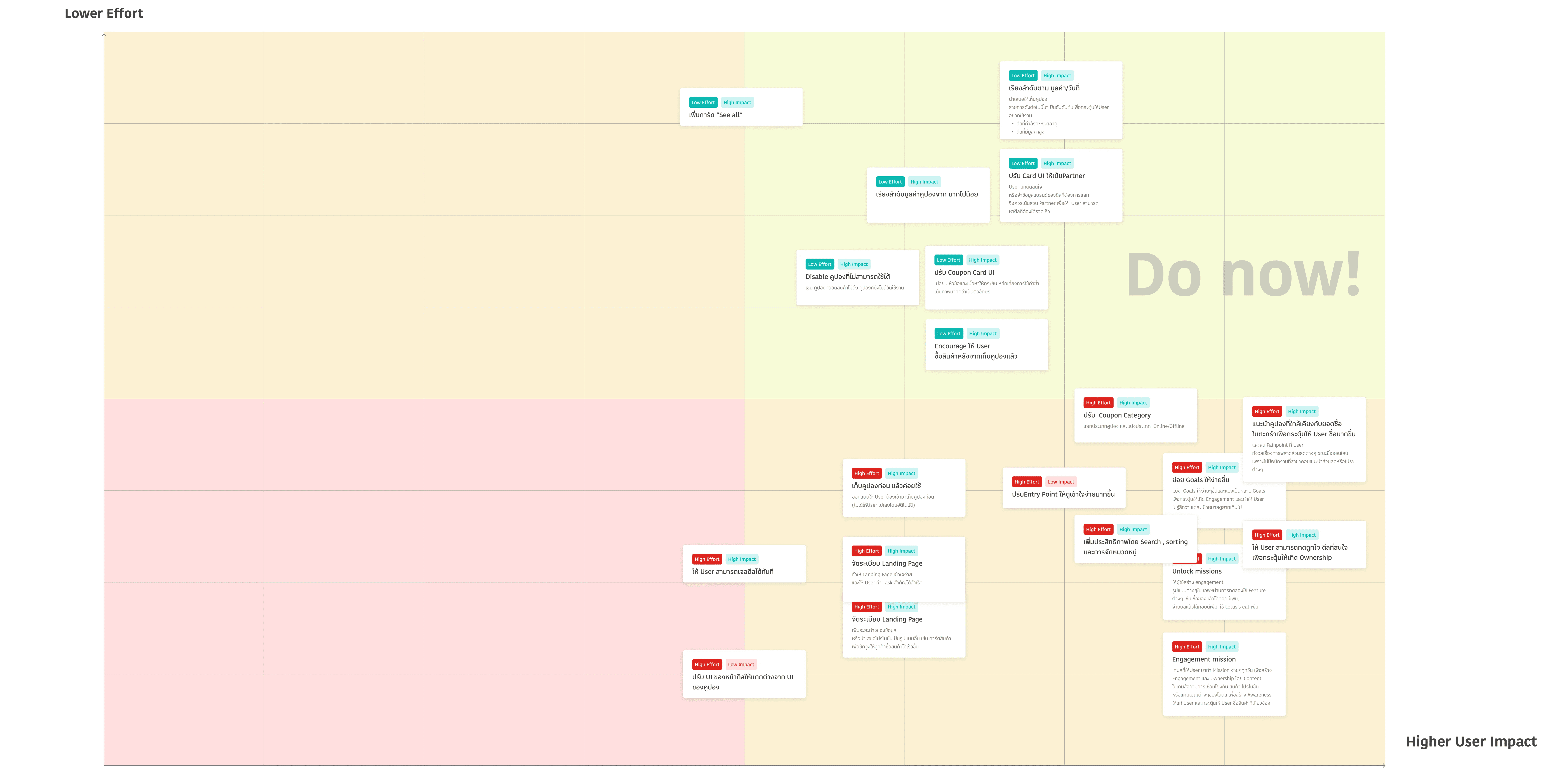
In a cross functional workshop, findings were turned into a buildable plan by mapping each opportunity against user impact and implementation effort.

The redesign: starting with what was actually broken
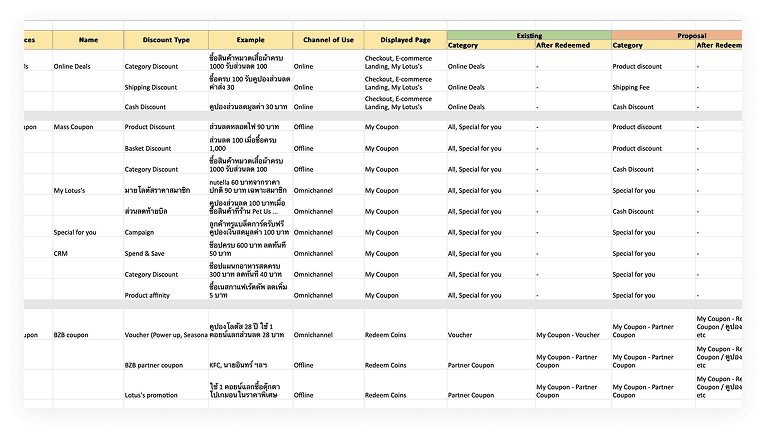
Working with the loyalty team, I reclassified every coupon type so the system matched how people actually search. Three root causes shaped the redesign:

  • Coupons were scattered across the shopping journey. Most users opened "My coupon" before they started shopping, using it to plan around whatever deals they had. The problem was that online coupons were not in "My coupon" at all — they only appeared at checkout, right at the end of the flow. By the time users saw them, they had already decided what to buy. I consolidated everything into "My coupon" so the full picture was there before the shop started, not after.

  • Categories did not match how people think. The original groupings were organized by business unit, not by what each coupon actually offered: online-side promotions in one pile, loyalty-member coupons in another, and a "Special for you" that was intended to feel personalized but was not actually customized. Users could not tell what it meant or whether it was for them. Before proposing anything, I sat with the loyalty team, mapped every coupon type they managed, and decoded the full structure. What came out was a function-based system: "Cash discount," "Product discount," and a "Special for you" now reserved for coupons genuinely tailored to that member.

  • The card design worked against scanning. Each coupon used a split-image format — half product graphic, half brand visual — that created visual noise when scrolling through a list. Titles and descriptions often repeated the same information in different words, and whether a coupon was online or in-store was easy to miss. I simplified the cards so the deal reads immediately: one clean image, non-redundant copy, and a visible online or offline badge.

Working with the loyalty team, I reclassified every coupon type so the system matched how people actually search. Three root causes shaped the redesign:

  • Coupons were scattered across the shopping journey. Most users opened "My coupon" before they started shopping, using it to plan around whatever deals they had. The problem was that online coupons were not in "My coupon" at all — they only appeared at checkout, right at the end of the flow. By the time users saw them, they had already decided what to buy. I consolidated everything into "My coupon" so the full picture was there before the shop started, not after.

  • Categories did not match how people think. The original groupings were organized by business unit, not by what each coupon actually offered: online-side promotions in one pile, loyalty-member coupons in another, and a "Special for you" that was intended to feel personalized but was not actually customized. Users could not tell what it meant or whether it was for them. Before proposing anything, I sat with the loyalty team, mapped every coupon type they managed, and decoded the full structure. What came out was a function-based system: "Cash discount," "Product discount," and a "Special for you" now reserved for coupons genuinely tailored to that member.

  • The card design worked against scanning. Each coupon used a split-image format — half product graphic, half brand visual — that created visual noise when scrolling through a list. Titles and descriptions often repeated the same information in different words, and whether a coupon was online or in-store was easy to miss. I simplified the cards so the deal reads immediately: one clean image, non-redundant copy, and a visible online or offline badge.

Coupon types have been categorized

Two directions, one trade-off
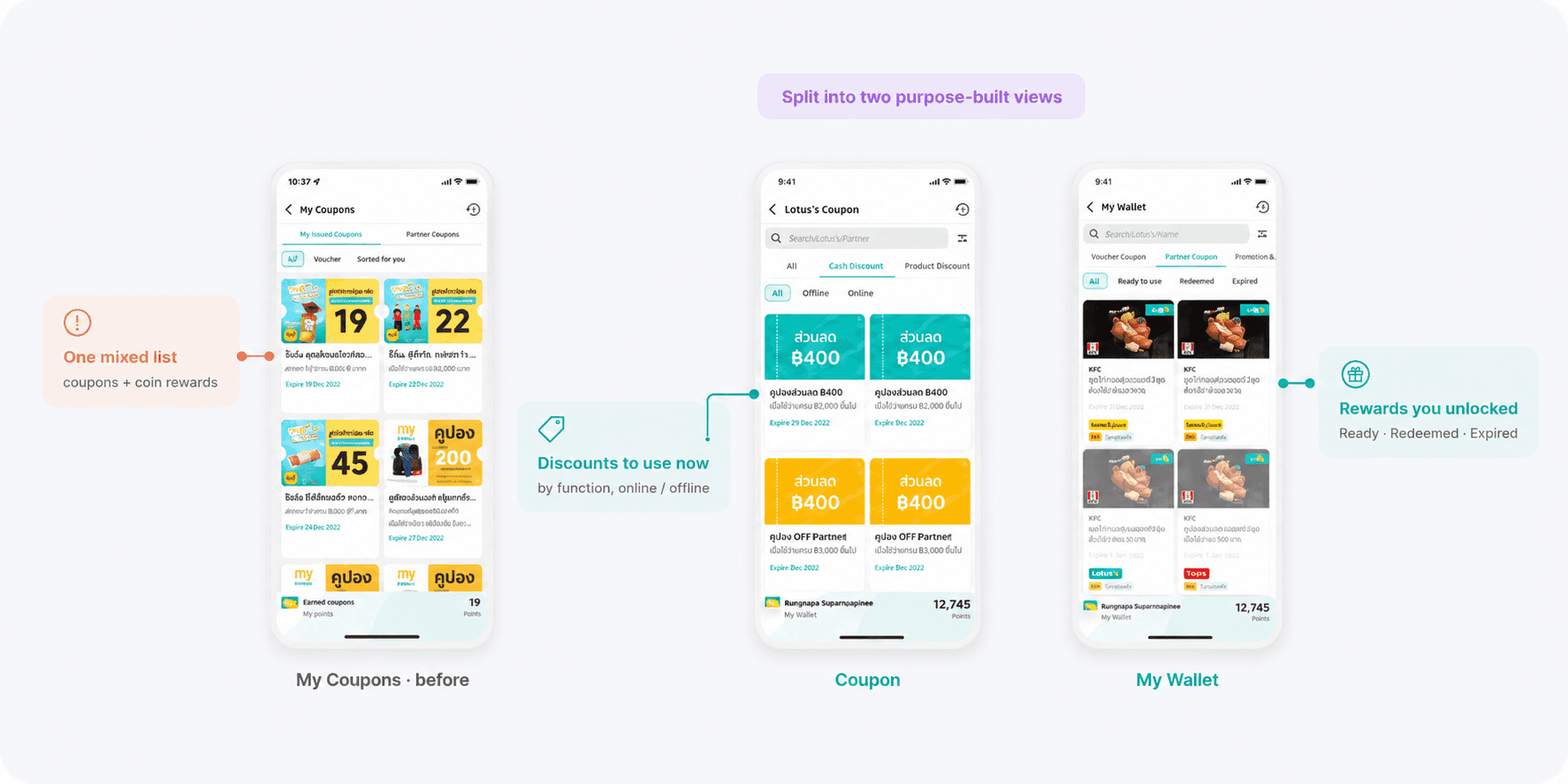
Partner coupons had a separate confusion. People could not tell whether a coupon was still usable or already spent in store. I split the tab into "Ready to use," "Redeemed," and "Expired," so the coupon's state is clear across the whole app-to-store journey.

Because the backend limits were real, I offered two directions so the team could decide with the trade-off in view:

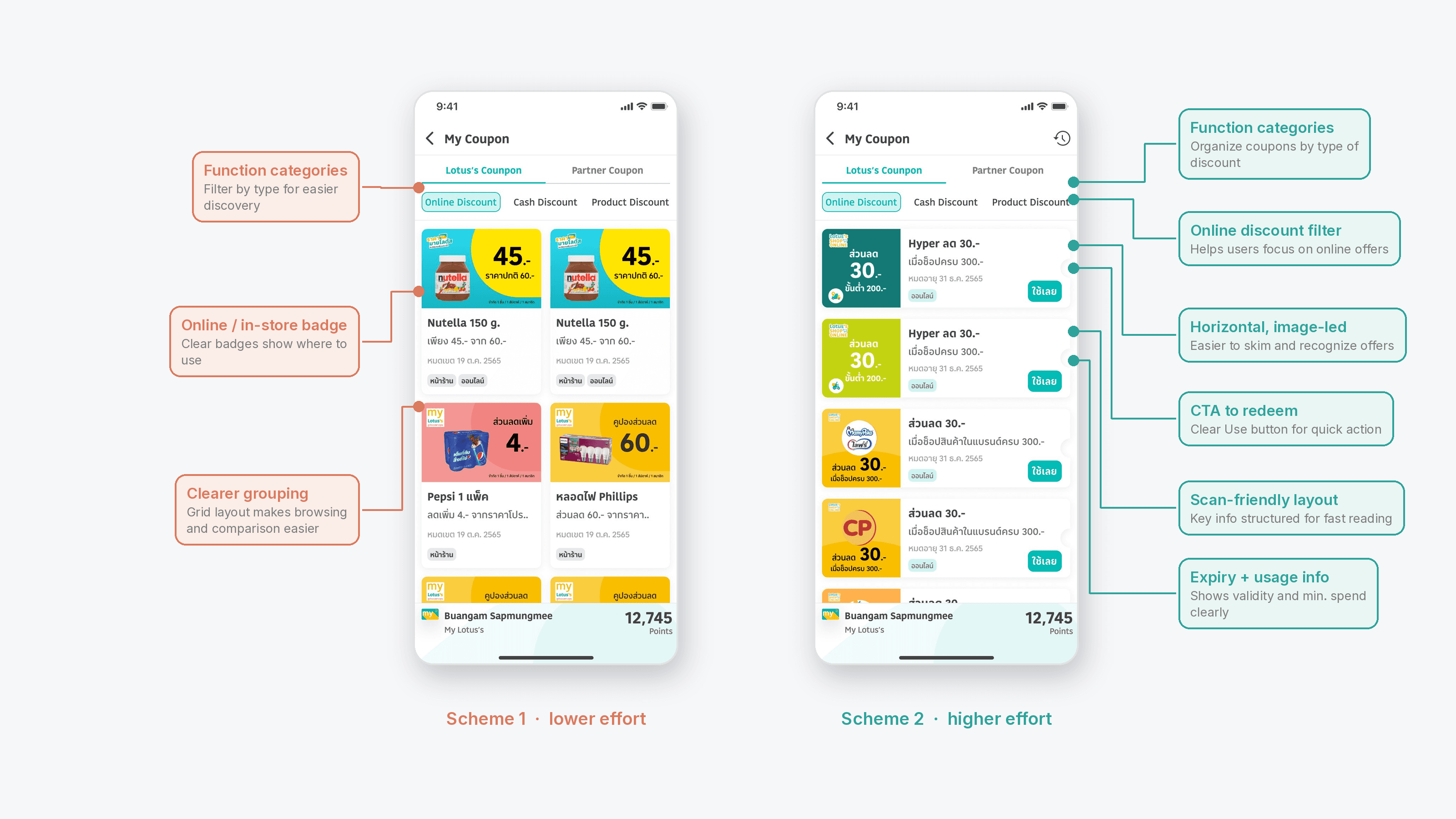
  • Scheme 1, lower effort. Works within the existing structure: clearer categories, less clutter, and an online or offline badge.

  • Scheme 2, higher effort. A larger rebuild into horizontal cards that lead with the product image, since testing showed people scan the picture first.

Two constraints shaped the work. Business wanted to keep each coupon's campaign colors so users remember where a deal came from. And online and offline coupons could not be filtered together because of a backend limit, so instead of a filter I used a clear online or offline badge. I designed around both, not against them.

Partner coupons had a separate confusion. People could not tell whether a coupon was still usable or already spent in store. I split the tab into "Ready to use," "Redeemed," and "Expired," so the coupon's state is clear across the whole app-to-store journey.

Because the backend limits were real, I offered two directions so the team could decide with the trade-off in view:

  • Scheme 1, lower effort. Works within the existing structure: clearer categories, less clutter, and an online or offline badge.

  • Scheme 2, higher effort. A larger rebuild into horizontal cards that lead with the product image, since testing showed people scan the picture first.

Two constraints shaped the work. Business wanted to keep each coupon's campaign colors so users remember where a deal came from. And online and offline coupons could not be filtered together because of a backend limit, so instead of a filter I used a clear online or offline badge. I designed around both, not against them.

Where it stands, and what I carried forward

The research pushed several teams across the company to prioritize user experience and shaped how we approached later features. The company kept working through the issues, ranked by user impact.

The coupon redesign is now in executive review ahead of development. I cross-checked it with quick tests first, and it was well received internally.

Even before a build, its real value is clear: it turned scattered user frustrations into one validated, focused product direction.

A few things stuck with me:

  • Real users surprise you. People opened "My coupon" in a way we never assumed, and that one observation reshaped the design.

  • The hidden problem is the real work. Users rarely name what is wrong. Finding the cause behind the complaint is the job.

  • Working across teams takes care. Business, marketing, design, and engineering think differently, and aligning them mattered as much as the research.

  • Design lives across the journey, not the screen. The real problems sat in the shopping flow, the online and offline channels, and the handoff to partner shops. Designing for that is how I work.

Every good experience
starts with a conversation.

Whether it’s a product, service, workflow, or story,

I’d love to explore how we can shape it together.

MIKIE ©2026, All rights reserved

Every good experience
starts with a conversation.

Whether it’s a product, service, workflow, or story,

I’d love to explore how we can shape it together.

MIKIE ©2026, All rights reserved

Every good experience
starts with a conversation.

Whether it’s a product, service, workflow, or story,

I’d love to explore how we can shape it together.

MIKIE ©2026, All rights reserved